Target Based Drug Discovery
Target-Based Drug Discovery and Structure-Based Drug Design
ITR performs Target-Based Drug Discovery to complement its well-established cell-based approaches. Target-based methodology is based on identifying a biological 'target', typically a protein, that is essential for the survival of the tuberculosis pathogen, Mycobacterium tuberculosis.
The protein is cloned, expressed, purified, and crystallized, and its 3-D structure determined by X-ray crystallography. The refined structure, ideally in complex with an inhibitor, is used as a basis to optimize the affinity leading to more promising 'lead-candidate' molecules.
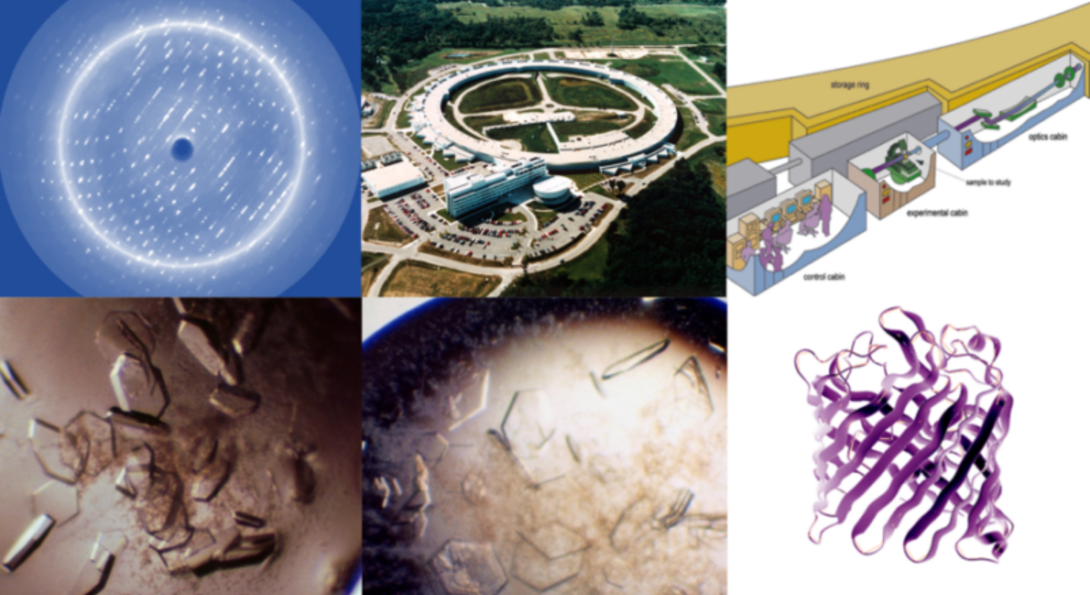
The crystallographic data are collected at the Advanced Photon Source (APS) at Argonne National Laboratory, Lemont (IL), shown in the aerial photo.
Image with 6 parts Heading link
Images from top left.
1. Diffraction pattern: protein crystals exposed to intense X-rays yield a diffraction pattern.
2.The Advanced Photon Source (APS) is the source of intense X-rays that are used to collect diffraction data from the protein (or protein-ligand) crystals.
3. Inside the circular experimental hall of the APS, the X-rays are focused and directed by mirrors to impinge upon the crystals. A remote hutch is used by the crystallographers to control the movement of the crystals in front of the beam, so that the diffraction data are collected.
4. A ribbon artistic rendition of the the protein structure obtained from the diffraction.
5. Native (unmodified) crystals of a protein.
6. Crystals of the same protein where the Sulphur containing amino acid Methionine (Met) has been replaced by Se-Met, an amino acid containing Selenium replacing the native Sulphur in Methionine. This is done to facilitate the structure solution by X-ray crystallographic methods.
Author-Support Heading link
Authors and Support
Author-Support
Author-Support
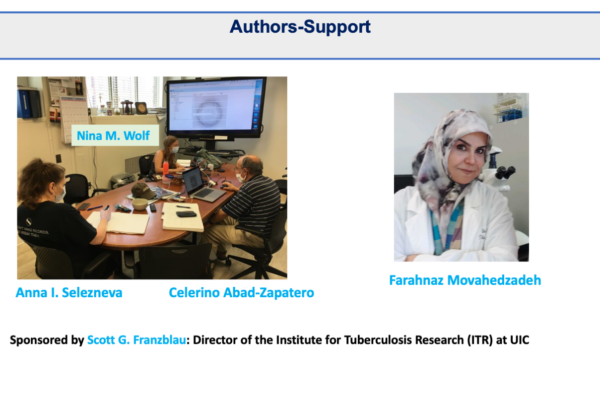
Nina M. Wolf : Post-Doctoral Researcher
Anna Selevneva: Visiting Scientist
Farad Movahadezaded (Principal Investigator)
Cele Abad-Zapatero (Principal Investigator)
Qurrat Ulain Siddiqui (Technician/ co-author)
Hiten Gupta (Graduate student/co-author)
The following funding is acknowledged: Potts Memorial
Foundation (grant No. G3541 to Farahnaz Movahedzadeh,
Celerino Abad-Zapatero); Chicago Biomedical Consortium
(grant No. 084679-00001 to Farahnaz Movahedzadeh,
Celerino Abad-Zapatero).
The Advanced Photon Source was supported by the US
Department of Energy (DE-AC02-06CH11357). We
acknowledge the help of the LS-CAT staff at the Advanced
Photon Source, Argonne National Laboratory with data
collection on the LS-CAT 21-ID beamlines.